

You can make money as an Amazon seller by choosing a clear model like private label, retail or online arbitrage, wholesale, dropshipping, or print-on-demand and then using smart product selection, optimized listings, and the right fulfillment method to turn sales into profit.
This guide shows you how to set up your seller account, pick and source products that sell, write listings that convert, price competitively, and use programs like FBA, Brand Registry, and affiliate or influencer options to add extra income.
You’ll also learn simple tactics to manage orders, automate tasks, and scale the business without losing control of cash flow or customer service.
Don’t Let Ad Spend Drain Your Profits, Get Amazon PPC Software Today
Key Business Models for Amazon Sellers
You can build profit with different approaches depending on how much time, money, and control you want. Each model below explains the core steps, costs, and what you must do to scale.
Get business support solutions today in low price
Private Label and Branding
Private label means you buy generic products, add your brand, and sell under your own listings. You control packaging, pricing, and product claims. This model often uses Fulfillment by Amazon (FBA) so you can scale fast and offer Prime shipping.
Key actions:
- Find a product with steady demand and gaps in quality.
- Source manufacturers (usually from overseas) and order samples.
- Design packaging, create a trademark, and enroll in Brand Registry.
- Optimize listing images, A+ Content, and sponsored ads.
Costs to plan for: product samples, tooling or design, minimum order quantities, shipping, Amazon fees, and advertising. Profit comes from margin between landed cost and sale price. If you build a recognizable brand, you increase pricing power and resale value.
Wholesale and Bulk Reselling
Wholesale on Amazon means you buy branded products in bulk from approved distributors and resell them at a markup. This model focuses on volume and stable supplier relationships rather than product creation.
What you do:
- Vet distributors and secure wholesale accounts.
- Negotiate pricing, lead times, and return policies.
- List products under existing ASINs or create listings if permitted.
- Use FBA or your own fulfillment to handle order flow.
Benefits include lower product development risk and fast time-to-list. Watch for MAP (minimum advertised price) policies and gated categories. Margins are usually smaller than private label, so success depends on turnover and tight cost control.
Check out our Amazon Product Launch & Ranking service here
Retail and Online Arbitrage
Retail arbitrage and online arbitrage involve buying discounted items from stores or websites and reselling them for profit. You find price differences between sources and Amazon’s marketplace.
Steps to follow:
- Scan clearance racks, liquidation lots, and online deals.
- Check Amazon fees, current buy box price, and shipping costs before buying.
- List items quickly; time-sensitive deals sell better.
- Use repricers or manual adjustments to remain competitive.
This model needs low startup cash and strong sourcing skills. You face higher competition and occasional restrictions on certain brands. It’s a common side-hustle that can scale into a larger operation if you systematize sourcing and fulfillment.
Handmade and Custom Products
If you make crafts, custom apparel, or bespoke items, Amazon Handmade and Amazon Custom let you reach buyers who want unique goods. This model emphasizes craftsmanship and personalization rather than mass production.
How to succeed:
- Apply to Amazon Handmade or use Amazon Custom for personalization options.
- Showcase clear photos and detailed customization fields.
- Price for labor and materials; factor in custom work time.
- Promote your shop via social media and optimize listings for niche keywords.
You keep creative control and often higher per-item margins, but volume can be lower than other models. Use Made-to-Order or print-on-demand services to reduce inventory risk while offering custom options.
Want more free traffic to your Amazon listings? Check out these 15 Viral TikTok Trends 2026 you can ride for explosive reach.
Getting Started: Setting Up Your Amazon Seller Account
You will register, pick a selling plan, set up payment and ID verification, and learn the key tools you’ll use to list, price, and ship products. Expect to provide business details, a bank account, and ID documents during setup.
Registering and Choosing a Selling Plan
Create your Amazon seller account at sell.amazon.com by entering your name, email, and password. You’ll then supply business information: business location, business type (individual or registered company), legal business name, and registration number if you have one.
Choose a selling plan:
- Individual plan: No monthly fee, pay per-item selling fees. Good if you sell fewer than ~40 items per month.
- Professional plan: Fixed monthly fee (usually billed around $39.99) plus selling fees. Best if you expect higher volume or need bulk listing tools.
You must also provide a phone number and address. Use a government-issued ID for identity verification. If you represent a business, indicate whether you’re a beneficial owner or a legal representative. This step readies your account to accept payments and list products.
Amazon Seller Central and Essential Tools
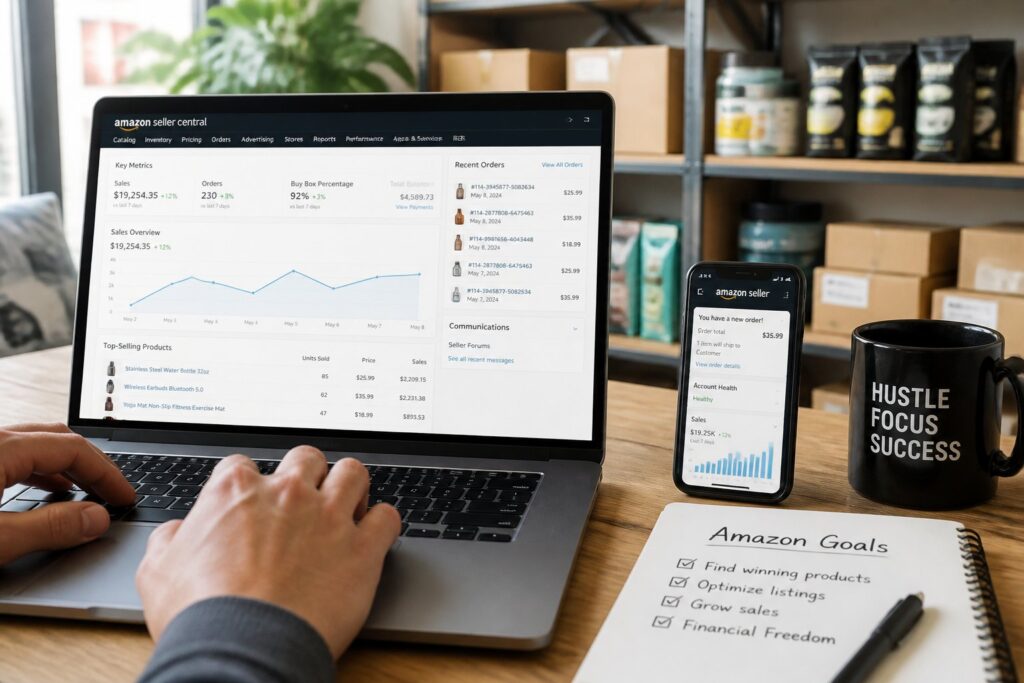
Seller Central is your control hub for listing products, managing inventory, and monitoring orders. Log in to access tools like the inventory manager, advertising dashboard, and reports section.
Key features to set up:
- Inventory management: Add SKUs, set product prices, and track stock.
- Shipping and fulfillment: Choose Fulfillment by Amazon (FBA) or fulfill orders yourself (FBM). FBA stores and ships products for you but adds fulfillment fees.
- Advertising: Create Sponsored Product campaigns from Seller Central to boost visibility.
- User access: Add employees or partners with role-based permissions.
Use the seller assistant and built-in reports to watch sales trends, returns, and account health metrics. Configure notifications and tax settings so you won’t miss performance alerts or payment holds.
Understanding Amazon Fees and Payments
Amazon charges several types of fees you must factor into pricing. Common fees include:
- Referral fees: A percentage of each sale that varies by category.
- Selling plan fee: Monthly Professional plan fee if you choose it.
- Fulfillment fees: If you use FBA, fees cover storage and shipping per unit.
- Closing or variable fees: Category-specific extras for certain items.
Set up your deposit bank account during registration. Amazon deposits proceeds after deducting fees on a regular schedule (typically every 14 days). Make sure the bank account name matches your legal or business name to avoid payment delays.
Monitor fee reports in Seller Central and build them into your product margins. That keeps your pricing accurate and helps you decide between FBA and FBM based on cost and expected sales volume.
Product Selection and Sourcing Strategies
Choose products with steady demand, healthy margins, and low shipping costs. Focus on clear data points, reliable suppliers, and a fulfillment method that matches your margins and risk tolerance.
Product Research and Market Analysis
Start by checking Amazon Best Sellers and category BSR to spot items that sell consistently. Look for products with BSR that shows steady sales over several months, not just a one-week spike.
Use competitor counts and review totals to gauge competition. Aim for niches with fewer strong brands and at least one seller making regular sales. Target price points where profit margins can exceed 20% after FBA fees and shipping.
Evaluate seasonality by viewing 12-month sales history. Avoid deeply seasonal items unless you plan inventory cycles. For wholesale product research, validate manufacturer catalogs and ASIN-level sales before buying cases.
Tools for Finding Profitable Products
Use product research tools like Jungle Scout or AMZScout to pull sales estimates, price history, and revenue ranges. These tools speed up filtering by monthly sales, weight, and price bands.
Combine tool data with barcode scanner apps when sourcing in retail or online arbitrage. Scan an item’s barcode to see current price, rank, and potential profit after fees.
Run every candidate through an FBA calculator to confirm net margin. Compare FBA versus FBM (Fulfillment by Merchant) scenarios FBM can lower fees but raises shipping and handling work. Keep a short list of 10–20 validated ideas before contacting suppliers.
Evaluating Suppliers and Inventory Management
Vet suppliers by asking for MOQ, lead times, sample photos, and compliance documents. Request unit cost, packaging specs, and shipping terms in writing. For private label or wholesale, confirm factory capability and references.
Plan inventory using lead time + safety stock. If you use FBA, factor in Amazon transfer times and inbound processing. For FBM, track packing speed and return handling.
Use simple inventory tools or spreadsheets to record SKU, reorder point, and turnover rate. Reorder when on-hand stock equals lead time demand plus safety stock. Keep barcodes and packing lists ready to avoid inbound holds.
Listing Optimization and Pricing Tactics

Ready to expand beyond Amazon?
Partner with a TikTok Shop Agency and tap into a whole new revenue stream.
You need clear product pages, smart keywords, and pricing that balances sales and profit. Focus on crisp titles, useful bullets, targeted search terms, and a pricing plan that reacts to competitors and demand.
Creating Compelling Product Listings
Write a title that includes the product type, key feature, and size or color. Keep it concise (aim under 60 characters when possible) and put the strongest keyword first.
Use five short bullet points to show benefits: one line for materials, one for size/dimensions, one for use cases, one for care/warranty, and one for what makes it better than competitors. Bullets should start with a short label (e.g., “Material:”) and then one clear fact.
Include 6–8 high-quality images: main white-background shot, close-ups of features, scale shot with dimensions, and a lifestyle image showing use. Add alt-text for each image with 1–2 keywords and a plain description (e.g., “stainless steel travel mug, 20 oz, black”).
If you’re a brand, use A+ Content to add comparison charts and feature callouts. This raises conversion and helps list products on Amazon look professional. Always test variations (title, main image, bullets) with small traffic experiments when possible.
SEO and Keyword Strategies
Start with keyword research using Amazon suggestions and competitive titles. Gather short-tail and long-tail terms: short-tail for visibility, long-tail for intent (e.g., “travel mug” vs “insulated 20 oz travel mug leakproof”). Track search volume and conversion text when available.
Place primary keywords in the title, secondary keywords in bullets and description, and additional terms in backend search fields. Use synonyms, abbreviations, and alternate spellings in backend fields, lowercase and space-separated. Avoid keyword stuffing; write naturally so shoppers can read details quickly.
Monitor performance by impressions, clicks, and conversion rate. Use Amazon PPC to test keyword performance and measure ACOS (advertising cost of sale). Pause low-converting keywords and scale bids on high-converting long-tail terms. Feed PPC learnings back into organic content to improve ranking.
Competitive Pricing and Profit Margins
Set a base price that covers all costs: product cost, shipping, Amazon fees, and returns. Use a pricing calculator to confirm minimum profitable price. Factor in promotion days and seasonal demand to avoid losses.
Watch competitor pricing and market trends daily for products you list. Use automated repricers for frequent categories to stay competitive without manual work. For your best-sellers, keep a narrower margin to win the Featured Offer; for niche items, keep higher margins.
Combine pricing tactics with advertising spend. If you lower price, expect ACOS to change, track how much ad spend you need to maintain profitability. Consider temporary discounts, coupons, or lightning deals to boost rank and reviews, then reset price to protect margins once momentum builds.
Leveraging Programs and Alternative Income Streams

Track Profits, Not Spreadsheets, See the SaaS That Sellers Trust
You can earn from Amazon without only selling physical inventory. Pick programs that match your skills content creation, print-on-demand, publishing, or microtasks and use them to add steady income and reduce risk.
Amazon Associates and Affiliate Opportunities
Amazon Associates pays you a commission when you send buyers to Amazon using special links. Sign up, create tracked links for product pages, and place them on your blog, YouTube descriptions, or social posts. You earn on qualifying purchases within a short cookie window, so promote items people will buy quickly, like gadgets, books, or household essentials.
Focus on high-converting placements: product review pages, gift guides, and comparison posts. Disclose the affiliate relationship to comply with rules. Track which links convert and test different calls to action and images. If you drive paid traffic, watch ROI closely because ad costs can exceed commissions.
Amazon Influencer Program and Merch on Demand
If you have an audience, apply to the Amazon Influencer Program to get a custom storefront and earn commissions from recommended products. Use short videos, social posts, and livestreams to showcase items and link back to your storefront for higher conversion.
Merch on Demand (Amazon Merch) lets you upload designs for shirts, hoodies, and accessories. Amazon handles printing, shipping, and customer service. Create niche-focused designs, optimize titles and bullet points for search, and price to cover royalties plus promotion costs. Combine both programs: promote your merch on your influencer storefront and cross-link from social content to boost visibility.
Self-Publishing: KDP and Audiobook Creation Exchange
Kindle Direct Publishing (KDP) lets you publish ebooks and print books and set prices that control royalties. Write to a clear audience, format files to Amazon specs, and use targeted keywords and categories to reach readers. Enroll select books in Kindle Unlimited for per-page read income if that fits your model.
For audiobooks, use Audiobook Creation Exchange (ACX) to find narrators or produce audio yourself and distribute through Audible. Pay attention to rights, royalty splits, and production quality poor audio hurts sales. Combine channels: link your KDP listings to audiobook versions and promote bundles to increase lifetime value per customer.
Other Amazon Earning Methods
Mechanical Turk (MTurk) offers small paid tasks if you need quick, low-skill work to supplement income. Pay per task varies; scale by accepting many simple tasks and keeping quality high.
Amazon Trade-In gives gift cards for eligible used electronics, books, and games. Use it to recoup cost on returned or surplus inventory. Amazon Flex lets you deliver packages for pay if you want local gig work and flexible hours.
You can also earn Amazon gift cards through promotions and some programs; redeem them to lower business costs. Each method has limits track time versus pay, tax rules, and program policies to choose the best mix for your goals.
Managing and Scaling Your Amazon Business
Keep tight control of orders, customer replies, advertising, and product choices so you turn sales into steady profit. Use tools and clear processes to handle fulfillment, run ads, gather reviews, and add new products without breaking cash flow.
Order Fulfillment and Customer Service
Choose a fulfillment method that fits your margins and time. If you use FBA, Amazon handles storage, shipping, and returns but charges fees that affect profits. If you use FBM or a 3PL, track shipping times, package quality, and return flows to avoid negative feedback.
Use the Amazon Seller App and Seller Assistant features to monitor orders and respond fast. Reply to messages within 24 hours. Create canned responses for common questions and a simple returns policy to cut handling time.
Measure key metrics: late shipment rate, order defect rate, and return rate. Fix causes quickly, improve packaging, change suppliers, or update listing info to match the product. Small fixes lower fees and keep the Buy Box.
Promotions, Advertising, and Reviews
Set clear goals for each campaign: profit, ACOS, or volume. Test Sponsored Products with narrow keywords first, then expand to broad match when you have conversions. Use negative keywords to stop wasteful spend.
Run time-limited coupons and Lightning Deals to spike sales and improve organic rank. Track ROI for each promotion and pause ones that lose money.
Ask for reviews using Amazon-approved follow-up via the Seller App or automated Seller Assistant tools. Send polite post-purchase messages that ask for feedback, not incentivize it. Monitor reviews daily and address complaints publicly to reduce damage.
Check out our Amazon Marketing Cloud Agency here
Scaling Up and Diversification
Scale when you consistently hit profitable sales and can fund more inventory without straining cash flow. Reinvest a portion of profits into top sellers first. Improve processes automate reorder points in your inventory tool and use the Amazon Seller App alerts to avoid stockouts.
Expand by adding related SKUs or bundling products to lift average order value. Consider new marketplaces (e.g., Amazon.ca or EU) after you localize listings and understand VAT/sales tax rules.
Hire virtual assistants or a part-time operations manager to handle customer service and listing updates. Use third-party tools for PPC automation and inventory forecasting to keep growth efficient and predictable.
Frequently Asked Questions
This section answers practical questions about earning profit, startup costs, account setup, product selection, fulfillment choices, and growth tactics. You’ll get clear steps, cost ranges, and real strategies you can apply.
What are the main ways sellers earn profit on Amazon (reselling, private label, wholesale, handmade)?
Reselling (retail arbitrage) means buying products at a discount and listing them for a markup. You can source from clearance racks, online deals, or liquidation, then relist on Amazon for a profit after fees.
Private label involves creating your own brand and sourcing products from manufacturers. You control pricing and listing content, which can lead to higher margins but requires upfront costs for samples, minimum orders, and branding.
Wholesale buys bulk stock directly from brands or distributors and sells at a markup. Margins tend to be lower than private label, but volume and steady supply can make it reliable.
Handmade lets you sell artisan or custom items you make yourself. Amazon Handmade has lower competition in some niches, but you’ll manage production and may need to price for time and materials.
How much does it cost to start selling on Amazon, and can you begin with little to no upfront budget?
Professional seller plan costs $39.99 per month plus selling fees; Individual plan has no monthly fee but charges $0.99 per sale. Expect referral fees (usually 8–45% depending on category) and variable closing fees.
Start-up inventory costs vary: reselling can start with under $100, while private label often needs $1,000–$5,000 for samples and initial stock. You can begin with low budget by dropshipping or selling used items, but growth is slower.
Also budget for shipping, labeling, photography, and optional tools (listing software, PPC). Use careful sourcing and test small batches to limit risk.
What steps are required to set up and verify an Amazon seller account?
Choose an Individual or Professional seller account on Amazon Seller Central. Prepare your email, phone, bank account, credit card, tax ID (or SSN), and government ID for verification.
Complete the identity verification process by uploading documents and responding to any follow-up requests. Add product listings, set shipping or FBA preferences, and enable payment deposit settings before you launch.
How do you choose profitable products to sell on Amazon while avoiding high-competition niches?
Look for products with steady demand and room for differentiation. Use sales estimators, Amazon Best Sellers rank, and keyword search volume to gauge demand and competition.
Aim for products with clear margins after Amazon fees, shipping, and cost of goods. Avoid categories dominated by big brands or saturated by many low-cost sellers unless you can offer a unique feature, bundle, or brand story.
Test with small orders, analyze conversion rates and PPC cost per sale, and pivot quickly if an item underperforms.
What is the difference between FBA and FBM, and how do you decide which fulfillment method is best?
FBA (Fulfillment by Amazon) stores your inventory in Amazon warehouses; Amazon handles packing, shipping, returns, and customer service. It often improves Buy Box eligibility and Prime visibility but adds storage and fulfillment fees.
FBM (Fulfillment by Merchant) means you store and ship orders yourself or via a third-party logistics provider. You control costs and handling but must manage shipping speed and customer service.
Choose FBA if you want faster scaling, Prime customers, and hands-off logistics. Choose FBM if margins are thin, items are oversized or restricted, or you need tighter control over inventory costs.
What strategies can help scale Amazon sales to reach consistent weekly income goals?
Optimize listings with strong titles, bullet points, and images to improve conversion rates. Run targeted PPC campaigns and use automatic-to-manual campaign loops to control ad spend.
Expand SKUs by adding variations, bundles, or complementary products to increase average order value. Monitor inventory closely to avoid stockouts and use repricing tools to stay competitive.
Collect reviews ethically and provide fast, clear customer service to build seller metrics. Track weekly revenue, ROI, and ad ACOS to adjust sourcing and marketing toward predictable income.